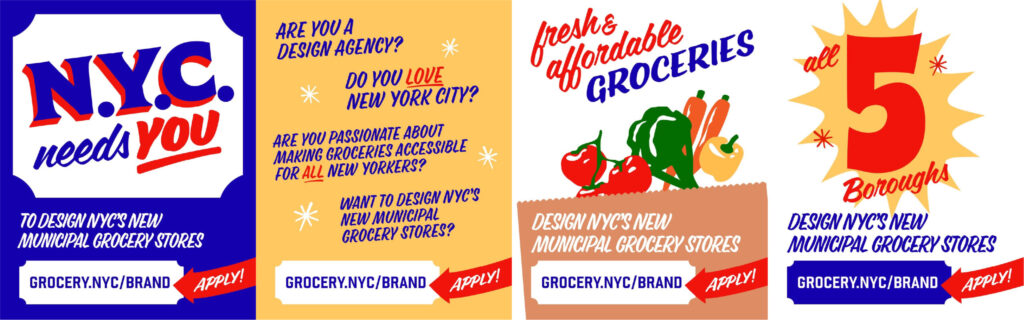
Whilst looking for new business opportunities in our studio’s core area of expertise – branding and retail design – our eyes popped out. The last thing we expected to see was a branding and retail design brief issued by the New York City Economic Development Corporation (NYC EDC) to develop the visual identity for a network of five municipal NYC-supported grocery stores. We won’t be pitching (for a few different reasons) but we do think it’s worth a moment to pore over the detail.
We all know that food prices have increased over the past few years thanks to a multitude of global events. And it’s something NYC mayor Zohran Mamdani is keenly aware of. As the NYC EDC says: “New York City is increasingly becoming unaffordable for working New Yorkers. When the cost of everyday necessities rises faster than paychecks, families feel it most at the checkout counter. In moments like these, City government has a responsibility to step in – especially when the market is not delivering affordability on its own.” An NY EDC press release states that grocery prices have risen 66% in the past decade, significantly outpacing the national average.
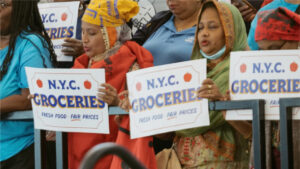
It’s a bold, admirable and progressive move, designed to bring down the cost of everyday groceries and household staples. It also aims to strengthen neighbourhood food access and demonstrate a new role for public sector leadership in food affordability. So how will it work?
Here are 10 need-to-knows:
1. NYC EDC aims to open five stores by the end of 2029, with the first store opening by the end of 2027.
2. They’ve stated that there’s long-term potential to open additional locations throughout NYC.
3. They’ll open one store in each of the five NYC boroughs. Two sites have already been identified: East Harlem, Manhatten (9,000 sq ft) and The Bronx (20,000 sq ft).
4. $70m in total has been allocated towards the construction of the stores.
5. The stores will sell a core basket of highly in-demand products.
6. The city will pay for the build, the rent and real estate costs. The operator is required to pass these savings on to customers via discounted prices.
7. Part of the design brief is to identify potential existing brand loyalty barriers to market entry. It shows NYC ED understands retail and its serious about making this work.
8. ‘N.Y.C. Groceries’ seems to be the working name but the development of a brand name is in scope in the branding and design brief.
9. Those pitching must demonstrate how they will meet a 30% participation goal in employing Minority and Women-Owned Business Enterprise-certified vendors.
10. The brief states they’re looking for a ‘fresh, vibrant’ brand identity.
So, could it work?
The backing of the city administration’s PR machine – and its indirect financial support – already gives this a good chance of success. On top of that, we assume the stores will be strategically located where their value proposition is most aligned with the local demographic. This is important, as stores can fail because of a mismatch between store proposition and local customer base.
But at the end of the day, the branding and store design will be key to whether the initiative flies or fails. The stores must successfully convey the proposition and be easy to shop. As we’ve recently seen with Amazon’s withdrawal of its Amazon go and Amazon Fresh physical stores, establishing a new store estate is no small feat. Even if there is a great store design concept behind them!)
We look forward to seeing the branding and store design concept unveiled next year.
You can read the full ‘N.Y.C. Groceries’ branding and retail design brief here. It’s one of the best written, clearest and most succinct retail design briefs we’ve read!